






Are you considering buying a home in one of the many gorgeous cities in Palm Beach County? Remember that purchase price isn’t everything: Your Palm Beach County property tax can significantly affect the affordability of your home.
One of the most confusing aspects of homeownership is property taxes. Even with similar values, you may pay more than your neighbor, and rates can vary a great deal from one city to the next.
How are Palm Beach County property taxes calculated? What are property tax rates in the county?
Here’s everything you want to know about Palm Beach county property taxes, including tax rates, how to pay, and exemptions that reduce your tax bill.
Table of Contents
Overview of Palm Beach County Property Taxes
Property taxes in Palm Beach County Florida are based on a property’s assessed value. The Palm Beach County property appraiser, Dorothy Jacks, is responsible for assessing the value of properties as of January 1 and sending annual Notice of Proposed Property Taxes to property owners.
- All properties have a “just value,” assessed value, and taxable value:
- Just value refers to the property’s market value.
- Assessed value is the just value minus any assessment limitations.
Taxable value is the assessed value minus property tax exemptions. The Palm Beach County tax collector uses this value to calculate taxes that are owed.
Under Florida law, the county appraiser must remove any exemptions from the property when it is sold and reassess it to make the just value and assessed value the same. The sales price will become the “just value” or market value.
Property tax millage rates, expressed in mills (1 mill = $1 per $1,000 of assessed value), are set by local governments, including cities, school districts, and counties, based on the revenue needs or levies determined by these entities to fund public services. These rates determine how much property tax you will pay per $1,000 of your property’s taxable value.
Once the County Commission, School Board, and other taxing bodies set a tax rate, the county appraiser multiplies the appropriate millage rate by the property’s taxable value and sends a certified Tax Roll to the Palm Beach County property tax collector.
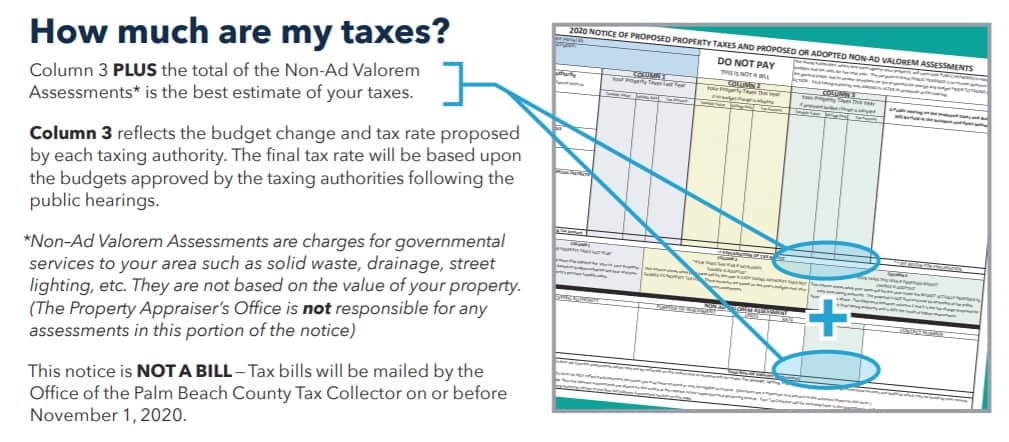
Note the graphic below shows “ad valorem” taxes – or your property taxes based on your property’s value – are added to “non-ad valorem assessments.” The latter refers to fees that may be added to your property tax bill by levying authorities. A common example is a Solid Waste Authority fee.

After the Palm Beach County property tax rates are set, the tax collector sends property tax bills, collects payments, and distributes the collected funds to local governments and taxing authorities like school districts, municipalities, and special districts. This process ensures that each entity receives the necessary funds to operate and provide services.
The tax collector is also responsible for selling tax certificates on properties when taxes become delinquent.
In August, a Notice of Proposed Property Taxes or Truth in Millage (TRIM) Notice is sent that shows your property’s taxable value starting on January 1.
This notice also includes proposed millage rates and estimated property taxes in Palm Beach county. This is not a bill but merely an estimate based on proposed tax rates, allowing property owners to understand and potentially challenge the proposed tax rates before they are finalized.
This challenge will take the form of a Palm Beach County Property Tax appeal.
Palm Beach County Property Tax Search
You can do a Palm Beach County tax collector property search online to view your property tax history, current tax bill, assessed value, appraisals, property tax exemptions, and current property tax rate.
To conduct a search and check your current millage rate, use the Property Appraiser Public Access (PAPA) tool and search by address, PCN, or property owner name. Under Property Detail then Taxes, click on “Property Tax Detail” and look for your Total Certified Millage Rate.
You can even access Palm Beach County Florida property tax records online with the PAPA mobile app!
Palm Beach County Property Tax Rates
Your Palm Beach property tax rate is expressed in mills. One mill is equal to $1 for every $1,000 of taxable value, keeping in mind that ‘taxable value’ is the assessed value of your property after all applicable exemptions have been subtracted.
As an example, let’s say your home’s value is assessed at $700,000, and you’re eligible for the Palm Beach County Property tax homestead exemption, which can total up to $50,000. Although there will be other intricacies and adjustments in the real world, for the example’s sake, we’ll then say your final taxable value is $650,000.
You will use the equation (Property value ÷ 1,000) x millage rate. So if your specific area’s millage rate is 22.34, that means you pay $22.34 for every $1,000 of taxable value, and you’d owe $14,521 in Palm Beach County property taxes. Since property values continue to rise quickly in the competitive Palm Beach County real estate market, you’ll end up paying more due to the rise in your home’s value.
Because rates vary by the city, town, or incorporated area in the county, you can use the Palm Beach County tax collector property search tool to see your actual current millage rate.
You will also see your proposed rate in your annual TRIM report.
Back to how property taxes in Palm Beach County, FL depend on where you live, let’s break them down so there are no surprises when you receive your bill:
- Unincorporated Palm Beach County tax rate: 16.4196 mills
- Belle Glade: 22.9615 mills
- Boca Raton: 17.1599 mills
- Boynton Beach: 20.2516 mills
- Delray Beach: 18.8998 mills
- Greenacres: 19.2615 mills
- Glenridge: 16.4196 mills
- Haverhill: 20.4696 mills
- Jupiter: 17.3447 mills
- Lake Worth Beach: 22.2742 mills
- North Palm Beach: 19.3016 mills
- Town of Palm Beach: 15.0126 mills
- Palm Beach Gardens: 18.1315 mills
- Royal Palm Beach: 18.3396 mills
- Wellington: 18.8896 mills
- West Palm Beach: 20.6022 mills
The differences in these millage rates reflect the various services and budgetary needs of each municipality or taxing district, and do note that these 2023 Palm Beach County FL property tax millage rates represent the total tax rates for each area, including all contributions from the relevant taxing authorities
Pay Palm Beach County Property Taxes | Tax Due Dates & How to Pay Property Taxes in Palm Beach County
You must pay Palm Beach County property taxes between November 1 and March 31. There is an early payment discount of 1% to 4%:
- 4% discount if paid by November 30
- 3% discount if paid by January 1st
- 2% discount if paid by January 31
- 1% discount if paid by February 28
Property taxes are delinquent the day after the date exceeds the Palm Beach County property tax due dates of November 1st to March 31st.
For 2024, taxes are delinquent on April 1. Once taxes are delinquent, they cannot be paid online.
Even if you did not receive a bill, you still need to pay property taxes Palm Beach County, so keeping up online with a Palm Beach County property tax search is always a good idea.
How to Pay Palm Beach County Property Taxes
You can pay Palm Beach County property tax bills via several payment options.
View this post on Instagram
These detailed instructions outline how to pay Palm Beach County property taxes online. You will need to search by owner name, address, or Property Control Number. You will see your current taxes owed. Click the “add to cart” button and then “checkout” to pay your bill.
Note that eChecks are free, but there is a 2.4% convenience fee for debit and credit card payments.
You can mail your payments to the address below. Your payment must be postmarked on or before the deadline to get the early payment discount. A check or money order should be made payable to “Tax Collector, PBC.”
Tax Collector, Palm Beach County
P.O. Box 3715
West Palm Beach, FL 33402-3715
Property taxes can be paid at PBC Tax Service Center locations. Service centers also have drop boxes for after-hours payments.
Installment Plans & Deferrals
If you have a homestead exemption and qualify, you can request a partial or full deferral of your property taxes. However, the deferral becomes a priority lien against your home, with interest accruing until it’s paid in full, which can equate to up to 7% per year.
If you can’t pay your taxes in full before they are delinquent, you can enroll in an installment plan after you fill out a Palm Beach County property tax installment plan application.
For 2024, applications must be submitted by April 30, so they’re currently closed.
View this post on Instagram
With an installment plan, your tax bill will be broken into four equal installments:
- First installment: Due by June 30 to receive a 6% discount. If paid by August 1, no discount is applied, and failure to meet this deadline means you are no longer eligible for the installment plan.
- Second installment: Due by September 30, offering a 4.5% discount on the total estimated taxes.
- Third installment: Due by December 31, covering half of the remaining balance after applying the June and September payments, with a 3% discount.
- Fourth installment: Due by March 31, paying off the remaining balance after previous payments have been applied.
This installment plan is designed to make property tax payments more manageable, spreading them out over time while also offering discounts for early payments.
Additional Information on Palm Beach Property Taxes
Below is additional information regarding office locations, appealing your property tax assessment, and exemptions to reduce your tax bill.
Palm Beach County Property Tax Appeal Information
Property owners have the right to appeal their property’s assessed value and allow exemptions for one or multiple properties. Your TRIM report in August will explain the taxes you will owe (pending budget changes that affect mill rates) and your property’s assessed value. Provided you do not agree, you can file an appeal with the Palm Beach County Value Adjustment Board (VAB) within 25 days.
This petition must be filed before the deadline. The petition includes instructions that must be followed. You must submit evidence to support your claim while the property appraiser is required to present information supporting the assessment.
Property Tax Exemptions
Palm Beach County property tax exemptions are administered by the property appraiser’s office. These exemptions reduce your home’s assessed value and your property tax bill.
Florida Homestead Exemption
The primary Palm Beach County property tax exemption is the homestead exemption. To qualify, the property must be your permanent residence. The Florida Homestead Exemption is $25,000 applied to the first $50,000 of assessed value if you owned the property as your primary residence on January 1 of the tax year.
There is an additional exemption of up to $25,000 if your assessed value is between $50,000 and $75,000. The first $25,000 exemption applies to all property taxes, including school district taxes, but the second exemption does not.
You can fill out your Florida homestead exemption application, which can be mailed to the property appraiser or filed in person at one of the service locations.
You can also e-file the homestead exemption application online.
Your application must be submitted by March 1.
Limited Income Senior Exemption
Palm Beach County seniors who are 65 or older with a homestead exemption can qualify for this additional exemption with limited income. Your income must be below the limit set by the Department of Revenue, or $35,167/year for 2024. This income limit does not apply to non-taxable Social Security income or tax-exempt bond interest.
The additional exemption only applies to specific taxing authorities, not school districts. The exemption is as follows for the following authorities.
- $50,000 exemption for Town of Haverhill, Town of Loxahatchee Groves & Village of Wellington
- $25,000 exemption for Palm Beach County, City of Boynton Beach, City of Lake Worth Beach, City of Palm Beach Gardens, Town of Lantana, Town of Jupiter, and Village of Palm Springs
- $5,000 exemption for the Village of Royal Palm Beach
Here is the Limited Income Senior Exemption application.
Other Property Tax Exemptions
All of these Palm Beach County Property tax exemptions require that you have a homestead exemption on the property.
- Widow & Widowers
- Civilian Disability
- Living Quarters of Parents or Grandparents (“Granny Flat” exemption)
- Disabled veteran
- Veterans 65+ with Combat Related Disabilities
- Active Duty Military
- Surviving Spouse of Military Veteran Who Died in the Line of Duty
- Disabled Law Enforcement & First Responder
- Institutional
3% Save Our Homes Cap
With the homestead exemption, you also qualify for the 3% Save Our Homes (SOH) cap. This cap limits increases to the assessed value of a property with a homestead exemption to no more than 3% each year or the percentage of change in the Consumer Price Index, whichever is lower.
Palm Beach Property Appraiser Office
The Palm Beach County property appraiser is Dorothy Jacks, CFA, AAS, elected to the position in 2016. The property appraiser has five office locations open Monday through Friday, 8:30 am to 5 pm. You can call 561-355-3230 for general questions or contact each office below.
- 301 N Olive Ave First Floor, West Palm Beach, FL 33401 (561) 355-2866
- North County Service Center, 3188 PGA Boulevard Second Floor, Palm Beach Gardens, FL 33410 (561) 624-6521
- Mid West County Service Center, 200 Civic Center Way # 200, Royal Palm Beach, FL 33411 (561) 784-1220
- Belle Glade Service Center, 2976 FL-15, Belle Glade, FL 33430 (561) 996-4890
- South County Service Center, 14925 Cumberland Dr, Delray Beach, FL 33446 (561) 276-1201
Palm Beach County Tax Collector Office
The Palm Beach tax collector is Anne M. Gannon. The office of the Constitutional Tax Collector processes vehicle titles, registrations, and driver’s licenses and collects property taxes. They are essentially the DMV in Florida as well as the tax collector.
Palm Beach County tax collector locations can be found here. The main office is located at the Governmental Center in West Palm Beach:
Constitutional Tax Collector, 301 N Olive Ave, West Palm Beach, FL 33401 (561) 355-2264
Palm Beach County, FL Property Tax FAQ
When Are Property Taxes Due in Palm Beach County, Florida?
Palm Beach County property taxes are due November 1 to March 31. Discounts are offered for paying early during this period. Taxes are delinquent on April 1.
How Do I Dispute Property Taxes in Palm Beach County?
You can dispute your assessed value, tax bill, and/or exemptions by filing this appeal with the Palm Beach County Value Adjustment Board after receiving your TRIM report in August.
Are Palm Beach County Property Taxes Paid in Arrears?
Property taxes are paid in arrears in Florida. This means your property taxes are paid at the end of the year (or beginning of the next year) for the prior year.
When Are Palm Beach County Property Taxes Mailed Out?
The Tax Collector mails Palm Beach County property tax bills on or shortly before November 1.
Unfortunately, we can’t help you with your property taxes in Palm Beach County, but we can definitely make the move into your new home easier! Give Meehan’s Family Moving, the best Palm Beach movers, a call at (561) 904-6000 for a stress-free move into your new home today!